



Love Sideloading? Android’s Developer Verification Rules Change Everything
Summary
- Google is rolling out its Android Developer Verification program which could make sideloading harder
- It requires developers to register themselves even if they want to distribute apps outside of the Play Store
- Here is everything you need to know about the Android Developer Verification Program
Android has always been known for its open source nature and the freedom to install apps from anywhere. But this could soon change with Google’s controversial developer verification programme. While the search giant recently introduced restrictions on sideloading for users, it is now doing the same for developers. Here’s everything you need to know about the new Android Developer Verification (ADV) Program.
What is the Android Developer Verification Program?
As part of the Android Developer Verification Program, Google will require all app developers to register and verify their apps so that users can install them on their devices. Devs will need to provide details such as their government ID, legal name, address, email address, and phone number. Organizations will need to submit their D-U-N-S number and verify their site.
The next step is to register the app’s package name by proving ownership. To do this, developers need to provide the APK of their app signed using their private key. This will connect the APK to the developer account for verification.
And if you are distributing to a select set of users, you will need to use a free developer account. This will let students, teachers, and hobbyists distribute apps to up to 20 authorized devices. If you distribute apps outside of the Play Store, you will need to use the new Android Developer Console for verification.
When Is It Rolling Out?
Android Developer Verification program registrations started rolling out on March 31, 2026. It will be available via the Android Developer and Play Developer console. If you are a developer, you need to register and verify your apps. As per the official timeline, from June 2026, early access will be available for limited accounts, such as students and hobbyist developers. In August 2026, the developer verification program and advanced flow will roll out globally. Finally, in September 2026, it will be enforced in Brazil, Indonesia, Thailand, and Singapore. In 2027, the requirement will continue rolling out globally.
Also Read:
- Best Compact Phones in 2026: Powerful Flagships That Fit Your Hand
- How AI is Killing Your Wallet: All Smartphone Price Hike Revealed
- Best Budget Gaming Laptops for Different Segments
How does it affect side loading?
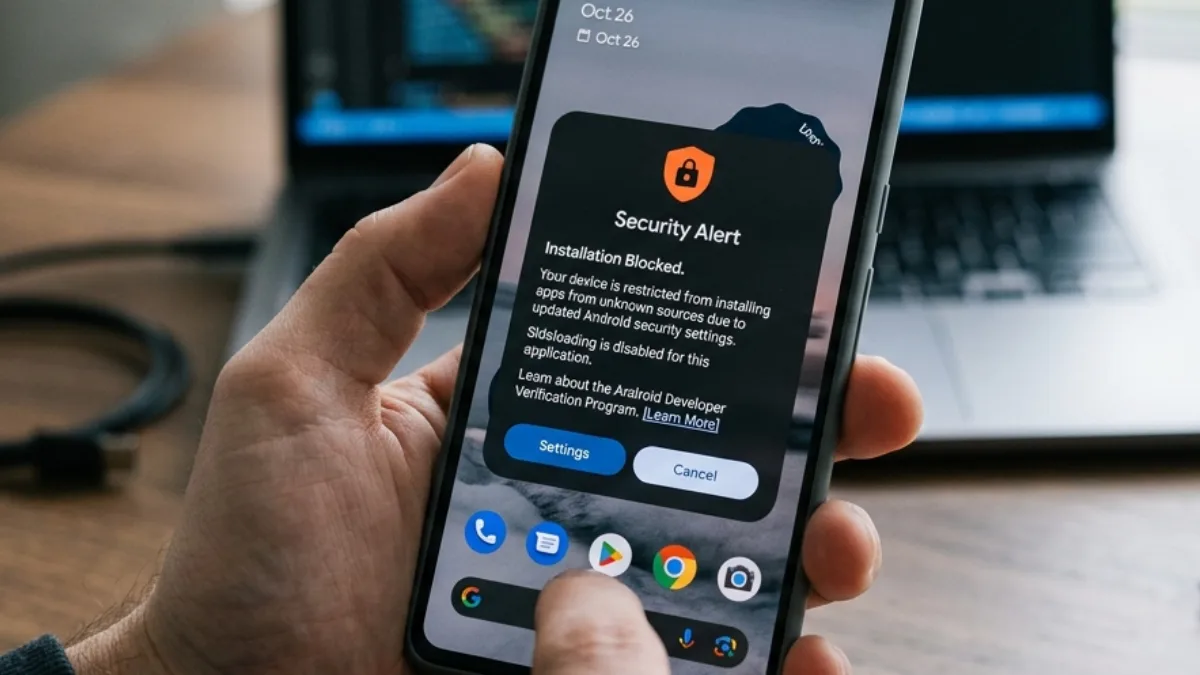
With restrictions set to roll out for both developers and end users, side loading certainly won’t be the same as before. Users will only be able to install apps from verified developers, and if the developer isn’t verified, you will see this error:
DEVELOPER_VERIFICATION_FAILED_REASON_DEVELOPER_BLOCKEDWhen a user attempts to install an APK file, the Android system now checks the signing certificate of the binary against a centralized database of registered developers. If there is no match or if the developer is blocked, the installation fails. Since this check occurs at a system level, you cannot bypass it by using a third-party app store or browser.
While Google maintains that sideloading isn’t going anywhere, the Android Developer Verification program, combined with the upcoming Advanced Flow for users, will make installing apps a multi-step process. This is how the process will look:
- Developer Mode Activation: The user must tap the Build Number seven times in the system settings.
- Anti-Coercion Check: A confirmation dialog where the user must attest that they are not being pressurized by a third party.
- Device Restart: The phone must be rebooted, which terminates any active remote-access sessions or screen-sharing tools a scammer might be using.
- The 24-Hour Security Wait: A mandatory one-day waiting period during which the user cannot finalize the permission.
- Biometric Re-authentication: After 24 hours, the user must confirm their intent using a PIN, fingerprint, or face unlock.
Once the process is complete, you can choose to install unverified apps for 7 days or indefinitely. While you are technically still sideloading apps, it generates enough friction, which essentially limits sideloading to developers and power users.
What else does it impact?
Third-party app stores and websites will be hit the hardest with the Android Developer Verification Program. F-Droid, the premier repository for free and open-source Android apps, faces an existential challenge. Since F-droid signs its apps with its own keys rather than the developer’s keys, approximately 85 percent of its catalogue could be blocked by Google.
Unless F-Droid signs up as a verified validator, which is highly unlikely, users won’t be able to tap into its massive open source catalogues. Similarly, other stores such as Obtanium, Droidify, and Neostore could face similar existential threats. Most open source app stores have developers who use a pseudonym to protect their identity. Google’s obligation to submit a government ID and address will end the era of anonymous software contribution.
Why Google is Pushing For ADV?
Google states that Android Developer Verification (ADV) is aimed at combating malware and malicious actors. The company further states that its analysis found 50 times more malware from sideloaded apps compared to the ones available on the Play Store.
Google’s argument stems from the theory that malicious actors can spread their apps without consequences. Even when the app is taken down, a scammer can upload another with a new identity. By imposing identity checks, Google aims to reduce the total volume of harmful apps on Android.
According to Google, the Android Developer Verification is like an ID check at an airport. The process confirms the identity of the traveler (developer) without necessarily performing a content review of their luggage (apps) at the time of registration. The move is aimed at confirming the identity of the developer rather than the content of the apps themselves.
It adds a layer of accountability by creating a new centralized registry in the Android developer console. For developers distributing their apps via the Play Store, most of this info is collected during the Play Console verification process introduced back in 2023. Although for millions of developers who distribute apps via third-party sites and app stores, it adds a new mandated gateway to the Android platform.
While Android is known for its open source nature, it has gained a notorious reputation due to scammers and malicious actors. It aims to create a trustworthy environment by requiring developers to verify themselves and end users to follow a long process for sideloading. Google’s intentions are in good faith, but the process might end up killing Android as we know it.